How to Set Up a Tiny Home Office in a Studio Apartment
In this article
You need to work from home, but you live in one room. There is no spare bedroom, no den, no door to close. A tiny home office in a studio apartment sounds like a contradiction, yet you can build one that works without giving up your couch or your sanity.
The trick is not finding more space. It is claiming a small, defined zone and making it earn its keep. You want a spot that says “work” when you sit down and disappears when you are done.
Here is how to do it, even if your whole place is 350 square feet and you share it with a bed, a kitchen, and a pile of laundry.
Key idea: A tiny home office works when you give work a fixed corner with the right gear, then teach yourself to switch it off at the end of the day.
In a hurry?
- Pick one corner and commit to it, even if it is just a folding table by the window.
- Go vertical with shelves and wall hooks so your floor stays clear.
- Keep work gear in a single bin you can pack away when you clock out.
- Use light, posture, and a clear “shutdown” cue to separate work from rest.
How to set up a tiny home office in a studio apartment
Start by walking your apartment and looking for dead space. The end of a kitchen counter, a wall next to your bed, the gap behind the couch, a wide windowsill. You are looking for one flat surface, or room to add one, plus a place to sit.
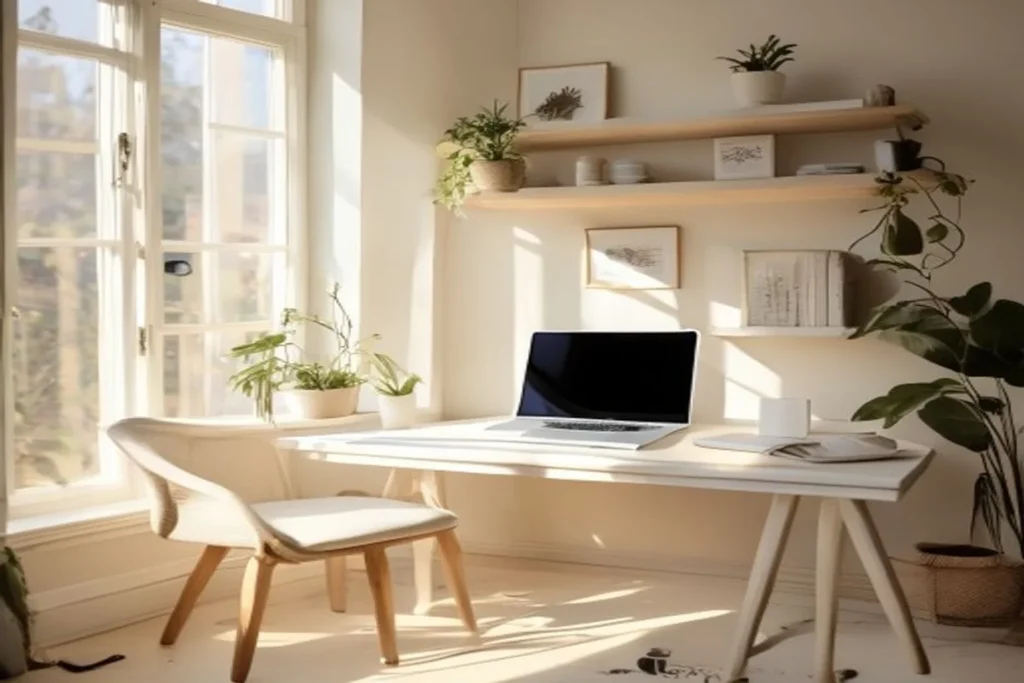
Once you pick the spot, build up instead of out. The floor is your most precious thing in a studio, so keep the desk small and put everything else on the wall. A narrow desk (24 to 36 inches wide) holds a laptop and a notebook with room to spare. Above it, one or two floating shelves carry the rest.
Aim for a zone you can set up and clear in under two minutes each. That speed keeps a tiny office alive instead of letting it become a clutter magnet.
The 5 steps to build your studio office
1) Claim your corner
Why it works: Your brain links places with behavior. When you always work in the same spot, sitting there flips a switch and you focus faster.
How to do it: Choose the corner with the least foot traffic and the best natural light. A spot by a window beats a dark wall every time. Mark it as yours with a small rug or a desk mat so it reads as a zone, not a random surface.
Common mistake: Working from bed or the couch “just for now.” It feels easy, but it wrecks your focus and your sleep, because the same spot ends up meaning work and rest at once.
2) Pick a desk that fits the room, not your wish list
Why it works: A small desk forces you to keep only what you use, and it leaves walking room around it. A huge desk in a studio just becomes a shelf for junk.
How to do it: Look at wall-mounted fold-down desks, narrow console tables, or a slim writing desk under 36 inches. A fold-down desk is the king of studios: it drops from the wall when you work and folds flat when you are done, giving the floor back to your life.
Common mistake: Buying a big L-shaped desk because it looks like a “real” office. It eats half the room and you end up resenting it.
3) Go vertical with storage
Why it works: Wall space is free real estate. Moving your books, chargers, and supplies up off the desk keeps the surface clear so you can actually work.
How to do it: Add two floating shelves above the desk and a pegboard for cables, scissors, and headphones. If you rent and cannot drill, command hooks and adhesive shelves handle light loads.
Common mistake: Stacking everything on the desk surface “to keep it handy.” Within a week you have no room to write and your laptop is buried.
4) Make it packable
Why it works: In a studio your office shares the room with everything else. If you can pack work away in one move, the space goes back to being your home at night.
How to do it: Keep your charger, notebook, pens, and any loose gear in one shallow bin or a zip pouch. At the end of the day, the laptop and the bin go on a shelf. Surface clear, brain clear.
Common mistake: Spreading gear across the apartment so nothing has a home. Then setup takes ten minutes and you skip it.
5) Get the light and the chair right
Why it works: A sore back and a glaring screen will drive you off your nice new desk and back onto the couch. Comfort is what makes the zone stick.
How to do it: Face a window if you can, so daylight hits your face, not your screen. Add a small clamp lamp for cloudy days and evenings. Use a real chair, even a cheap one with a cushion, instead of a kitchen stool. Raise your laptop on a stand or a few books so the top of the screen sits at eye level.
Common mistake: Putting the desk so the window is behind your screen. The backlight strains your eyes and washes out your monitor on video calls.
Studio office questions
How much space do you really need for a home office in a studio?
About 3 by 3 feet is enough for a working corner. You need room for a narrow desk, a chair, and walking space to slide in and out. Everything else goes on the wall.
Can you have a home office without a desk?
Yes. A wide windowsill, a fold-down wall shelf, or even a sturdy lap desk on the couch can work for light tasks. The fixed spot matters more than the furniture.
How do you separate work and rest in one room?
Use cues your brain can read. Pack the work bin away, close the laptop, switch off the desk lamp, and turn on a different light. The change in the room tells you the day is done.
What furniture do I need for a studio home office?
Keep it to a narrow desk or fold-down shelf, one comfortable chair, and two wall shelves. That covers most remote work without crowding the room.
Is it okay to use my kitchen table as a desk?
For short term, yes, but it tends to fail because you have to clear it for meals. A small dedicated corner you never pack up for other uses will hold up better.
How do I keep video calls looking professional in a studio?
Face a window or a lamp so your face is lit, and keep one tidy shelf or a plain wall behind you. You do not need a fake background, just a clean three-foot zone in frame.
Your checklist
- Choose your corner and add a rug or mat to define it.
- Set up a narrow desk or fold-down shelf and a real chair.
- Mount two shelves and a pegboard to clear the desk surface.
- Stock one packable bin with your charger, notebook, and small gear.
Avoid these
- Working from bed or the couch, which blurs the line between work and sleep.
- Buying furniture that is too big, so the floor disappears and the room feels cramped.
- Leaving gear out all the time, so the office never resets and the clutter spreads.
Worth trying
Set up your corner facing the door or the open part of the room, not a blank wall. In a tiny space, staring at a wall all day makes the room feel smaller and the work feel longer. A clear sightline tricks your brain into thinking the space is bigger, and you will want to sit there.
Separate work from sleep
A tiny home office is less about square footage and more about a fixed corner you can set up and clear in two minutes. Pick your spot, keep the desk small, send everything else up the wall, and build a shutdown habit so the room turns back into home at night. Start today: walk your apartment, find the one corner with decent light, and put a chair there. That single move is your office.