How to Organize a Small Closet With No Extra Furniture
Small closet, too many clothes, no system. Everything ends up in a pile or crammed together so tight you can’t see what you own.
You don’t need new furniture. You need a different way of using the space you already have.
> 💡 **Key idea:** Most small closets waste 60% of their vertical space. Reorganizing around height, not just width, doubles usable storage without adding a single piece of furniture.
## Quick summary (for busy people)
– ✔️ Sort by category first (clothes, shoes, accessories) not by color or season
– ✔️ Use every inch of vertical space, not just the hanging rod
– ✔️ Shelf dividers and over-door pockets are the two highest-impact additions under $20
– ✔️ Hangers matter: matching slim hangers recover 30% more rod space
## Why small closets feel impossible
Most closets get used in a single layer. Clothes on the rod, shoes on the floor, everything else piled on the shelf.
That leaves the entire upper zone and door back completely unused.
The fix: think in zones, not in piles.
## How to reorganize without adding furniture
### 1) Empty it completely first
– **Why it works:** You can’t see what you have or where it should go until everything is out
– **How to do it:** Pull everything out. Sort into four piles: keep, donate, trash, relocate (items that don’t belong in the closet at all). Only return the “keep” pile
– **Common mistake:** Reorganizing around what’s already in there. Starting fresh reveals patterns you can’t see otherwise
### 2) Switch to matching slim hangers
– **Why it works:** Standard plastic hangers are 2-3x thicker than velvet slim hangers. Switching recovers 30-40% more rod space with zero additional furniture
– **How to do it:** Buy one pack of slim velvet hangers. Transfer all clothes. Return the old hangers to storage or donate them
– **Common mistake:** Mixing hanger types. Mixed hangers create uneven spacing and clothes fall constantly
### 3) Use a second hanging rod for short items
– **Why it works:** Most clothes don’t need full-length hanging. Shirts, jackets, and folded pants only need half the rod height: a second rod below doubles that zone
– **How to do it:** Install a hanging rod extender (hook-over, no drilling) below the main rod. Use the bottom rod for shirts and shorter items, top rod for dresses and longer pieces
– **Common mistake:** Hanging long dresses on the lower rod. Keep short items below, long items above
### 4) Stack the floor zone with shoe storage
– **Why it works:** Shoes on the floor take 3x more space than shoes in a stacked organizer
– **How to do it:** A stackable clear shoe box tower or a fabric over-door shoe holder keeps shoes organized and visible. If using the floor, at least line them in pairs toe-to-heel to halve the footprint
– **Common mistake:** Storing shoes you never wear in prime floor space. Keep seasonal or rarely-used shoes in boxes on the upper shelf
### 5) Use the upper shelf for bins, not loose items
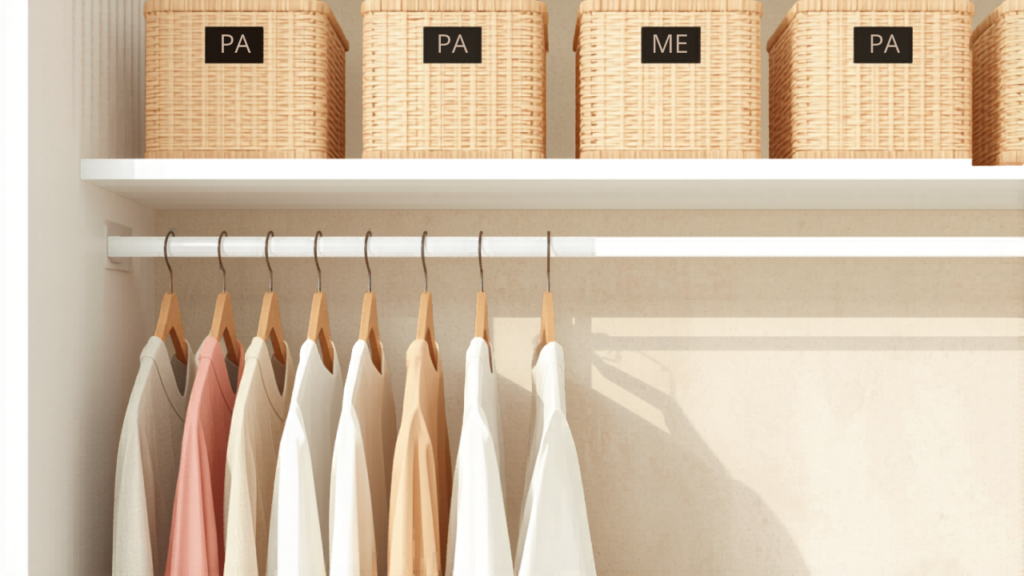
– **Why it works:** Loose items on the upper shelf become a jumble you can’t see or reach. Labeled bins keep it functional
– **How to do it:** Place two or three labeled fabric bins on the upper shelf: one for accessories, one for off-season items, one for backup supplies. Label the front so you never have to dig
– **Common mistake:** Putting frequently used items in the high bin. Upper shelf is for low-frequency items only
### 6) Add an over-door organizer on the closet door
– **Why it works:** The back of the closet door is flat, accessible, and completely wasted in most setups
– **How to do it:** Hang an over-door pocket organizer. Use it for accessories, belts, small bags, or folded scarves, items that currently live on the shelf or floor
– **Common mistake:** Overloading the organizer. If pockets are bulging, items will fall out and the door won’t close properly
## Quick answers
### What’s the best way to organize a small closet without buying new furniture?
Empty it completely, switch to slim hangers, add a second hanging rod for short items, stack the floor zone with shoe storage, use labeled bins on the upper shelf, and add an over-door organizer. No new furniture needed.
### How often should you audit a small closet?
Every 6 months: once before winter, once before summer. 20 minutes per session keeps the donation bag full and the closet functional.
### What happens if you keep cramming more into a small closet?
You stop seeing what you own, stop wearing half of it, and the closet becomes a source of daily stress. The fix is almost always removing things, not adding storage.
## Practical checklist
– [ ] Closet emptied, sorted into keep/donate/trash/relocate
– [ ] All clothes transferred to slim matching hangers
– [ ] Second hanging rod installed for short items
– [ ] Shoes organized in floor zone (stacked or paired toe-to-heel)
– [ ] Upper shelf holds only labeled bins for low-frequency items
– [ ] Over-door organizer added for accessories and small items
## Common mistakes
1. Reorganizing without emptying first. You can’t see the space until it’s clear
2. Mixed hanger types. Uniform hangers are non-negotiable for a small rod
3. Upper shelf as catch-all. If it’s not in a labeled bin, it will become a pile
## Pro tip
After reorganizing, take a photo of the closet from the door. When it starts slipping again, compare to the photo. That visual contrast is the fastest motivation to do a quick reset.
## Conclusion
One full sort, slim hangers, a second rod, and three labeled bins. That’s a functional small closet: no furniture, no drilling, no designer solutions required.
If this helped, try these
- Small Bedroom Setup: 6 Layout Moves That Create Space
- One-Bag Storage System: How to Cut Clutter in Half
- The Drawer-by-Drawer Method
## FAQ
### What’s the best hanger for a small closet?
Slim velvet hangers. They’re thinner, clothes don’t slide off, and they’re uniform, which makes the rod look organized even when it’s full.
### Can I use a portable closet instead of reorganizing?
A portable closet adds space but doesn’t solve the underlying organization problem. Organize first: you might not need the extra furniture.
### What do I do with clothes that don’t fit but I want to keep?
Box them, label the box with a date, and store it under the bed or in a separate bin. If you don’t open the box in 12 months, donate without opening.