The One-In-One-Out Rule: How to Stop Clutter Before It Starts
In this article
You clean up on Sunday. By Wednesday the counter is covered again. Sound familiar? In a small apartment, clutter does not creep in slowly. It piles up fast because there is nowhere to hide it. The one-in-one-out rule fixes this at the source, before the mess even starts.
The idea is simple. Every time something new comes into your place, something old leaves. No new shelf needed. No big purge weekend. Just one small swap that keeps your stuff at a steady, livable level.
If you live in a studio or a tight one-bedroom and feel like you are always tidying but never done, this is the habit that breaks the cycle.
Key idea: Keep your belongings at a fixed level by removing one item every time you bring a new one in.
In a hurry?
- When you buy or receive something new, send one similar thing out the door.
- It works because your total stuff stops growing, so clutter never gets a head start.
- Start with the categories that pile up fastest: clothes, kitchen gadgets, and beauty products.
- You do not need extra storage. You need a steady ceiling on how much you own.
What the one-in-one-out rule actually means
The one-in-one-out rule is a simple cap on your belongings. One item in, one item out, in the same category. A new pair of shoes means an old pair leaves. A new mug means a chipped one goes.
This is not about owning the bare minimum. You can keep as much as you like. The rule just stops the number from climbing without you noticing. That slow climb is what turns a tidy apartment into a cramped one.
Most clutter problems are not a storage problem. They are an inflow problem. Things come in faster than they go out, and small spaces have no buffer. This rule balances the two so your space stays the same size it always was.
How to use the one-in-one-out rule in 4 steps
1) Pick the categories that grow fastest
Why it works: Not everything you own multiplies. But a few categories do, and those are where clutter wins. Targeting them gives you the most relief for the least effort.
How to do it: Look around and name your top three offenders. For most renters it is clothes, kitchen gear, and bathroom products. Apply the rule strictly to those three first. Ignore the rest for now.
Common mistake: Trying to police every object in your home at once. You will burn out by day two. Start narrow and let the habit spread on its own.
2) Make the “out” happen the same day
Why it works: If you wait, the old item never leaves. It sits in a corner waiting for a donation trip that never comes, and now you have both things.
How to do it: The moment you unbox the new thing, pull the old one out and put it by the door. Bag it. The next time you leave, it goes with you to the donation bin or the trash.
Common mistake: Letting the “out” pile live in your apartment for weeks. A waiting pile is just clutter with a good excuse. Set a hard rule: it leaves within two days.
3) Keep a small outbox by the door
Why it works: A dedicated spot removes the friction. You always know where the leaving items go, so you actually follow through instead of deciding each time.
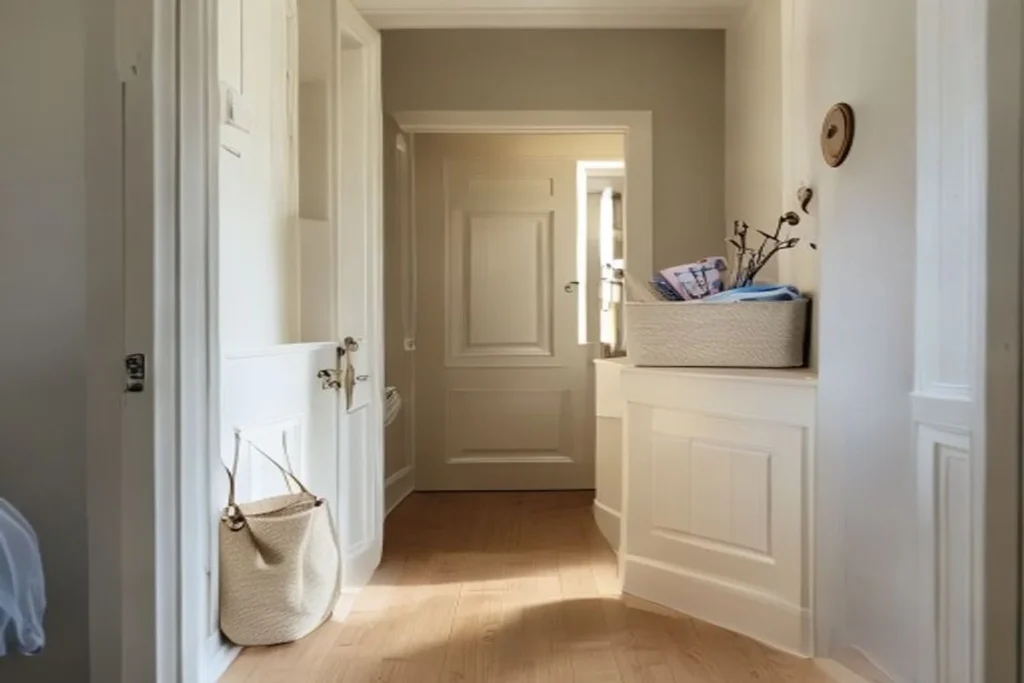
How to do it: Use one reusable bag or a small bin near your entry. Whenever something is on its way out, it drops in there. When it is full, you take it. That is the whole system.
Common mistake: Storing the outbox somewhere you never look, like the back of a closet. Keep it in your path so it nags you to empty it.
4) Use the rule for gifts and freebies too
Why it works: Free stuff is sneaky. It feels harmless because you did not pay for it, but it takes up the same space as anything you bought.
How to do it: Treat a gift, a swag bag, or a hand-me-down like any other “in.” If you keep it, something else leaves. If nothing is worth swapping out, that is a sign you did not really want the new thing.
Common mistake: Giving freebies a pass. That is exactly how junk drawers and overflowing shelves get built.
One-in-one-out questions
Does the one-in-one-out rule mean I can never own more stuff?
No. It freezes your total at whatever level feels right today. If you want more of something, raise the cap on purpose. The rule just makes growth a choice instead of an accident.
What counts as a fair “out” item?
Match the category, not the exact item. A new shirt can mean any old shirt leaves, not specifically a shirt you never liked. The point is keeping the total steady, so any item in that group counts.
How long until it feels automatic?
About three to four weeks for the categories you focus on. The first few swaps take thought. After that your brain pairs “buying” with “removing” on its own.
Can the one-in-one-out rule work for a whole family?
Yes, but give each person their own categories and outbox. Shared rules fall apart when nobody owns the swap. Personal ownership keeps it honest.
What if I am trying to downsize, not just maintain?
Switch to one-in-two-out for a while. You keep buying what you need but shrink your total over time. Once you hit a comfortable level, go back to one-in-one-out to hold it there.
Does this replace a full declutter?
No. The rule keeps clutter from coming back, but it does not clear an existing pile. Do one quick declutter first, then use the rule to protect the result.
Run through this
- Name your three fastest-growing categories today.
- Set up one outbox bag or bin near your front door.
- Next time you buy something, pull one matching item out before you put the new one away.
- Empty the outbox the next time you leave the apartment.
Where people go wrong
- Letting the “out” item linger inside for weeks instead of moving it out within two days.
- Applying the rule to every category at once and quitting from overwhelm.
- Giving gifts, samples, and freebies a free pass when they take up just as much room.
Worth trying
Run a tougher version on impulse buys: one in, two out. If you are about to grab something you do not really need, deciding what two things must leave usually kills the urge before you reach the register. It turns a quick splurge into a real decision.
The ceiling holds itself
Clutter in a small apartment is almost always an inflow problem, not a space problem. The one-in-one-out rule keeps your total belongings flat, so the place you tidied stays tidy. Pick your three messiest categories, set up an outbox by the door, and make your next purchase trigger a swap. That is the whole habit, and it pays off every single day.