The Touch-It-Once Rule: How to Stop Apartment Clutter Before It Forms
In this article
Clutter isn’t caused by having too much stuff. It’s caused by putting stuff down instead of putting stuff away. A jacket on the chair, mail on the counter, shoes by the couch. Each one is a 2-second decision that gets deferred, and deferred decisions stack up into apartment-wide mess.
The touch-it-once rule is the simplest anti-clutter system that exists. One principle: when you pick something up, it goes to its final destination. Not a halfway stop, not a temporary pile. One touch, one home.
💡 Key idea: Clutter is deferred decisions. The touch-it-once rule doesn’t fight clutter, it prevents it from forming. When every item gets placed once instead of three times, your apartment stays clear without any extra cleaning time.
Skim this
- ✔️ One principle, applied constantly, transforms any apartment
- ✔️ Zero extra time, because you were going to touch the item anyway
- ✔️ Eliminates the “pile” phenomenon at the root
- ✔️ Works alongside any other decluttering system
Why clutter forms even when you clean regularly
Clean someone’s apartment on Saturday, visit again Wednesday. There are piles. Those piles didn’t come from new purchases. They came from people picking up items, setting them down somewhere intermediate, and never finishing the move.
Each pile is a chain of three-quarter decisions. The coat comes off, gets draped on the chair, stays for days. The cup is used, put on the coffee table, stays for days. The bag comes in, lands on the dining table, stays for days. The touch-it-once rule breaks that chain.
The touch-it-once rule in practice
1) When you pick up an item, decide its final destination immediately
- Why it works: The decision is the bottleneck, not the action. Once the destination is clear, moving there takes seconds.
- How to do it: Train yourself to ask: where does this actually live? Not “where is it easy to put down right now?” but “where does it belong when it’s not in use?” Take it there. Immediately.
- Common mistake: Deciding “I’ll sort this later”. Later is where clutter lives. The decision deferred is the pile created.
2) If you can’t put it away now, don’t pick it up now
- Why it works: Picking something up and not putting it away is worse than not picking it up at all. The item is now out of context and even harder to place.
- How to do it: If you’re rushing out the door and grab mail from the mailbox, either carry it to where it lives (a mail folder, a trash bin) or leave it in the mailbox until you can. Don’t dump it on the counter in between.
- Common mistake: The “I’ll sort the mail later” ritual. That creates the classic kitchen counter pile that grows for weeks.
3) Every item needs a defined “home”
- Why it works: You can’t touch-it-once if the item has no destination. Homeless items become clutter by default.
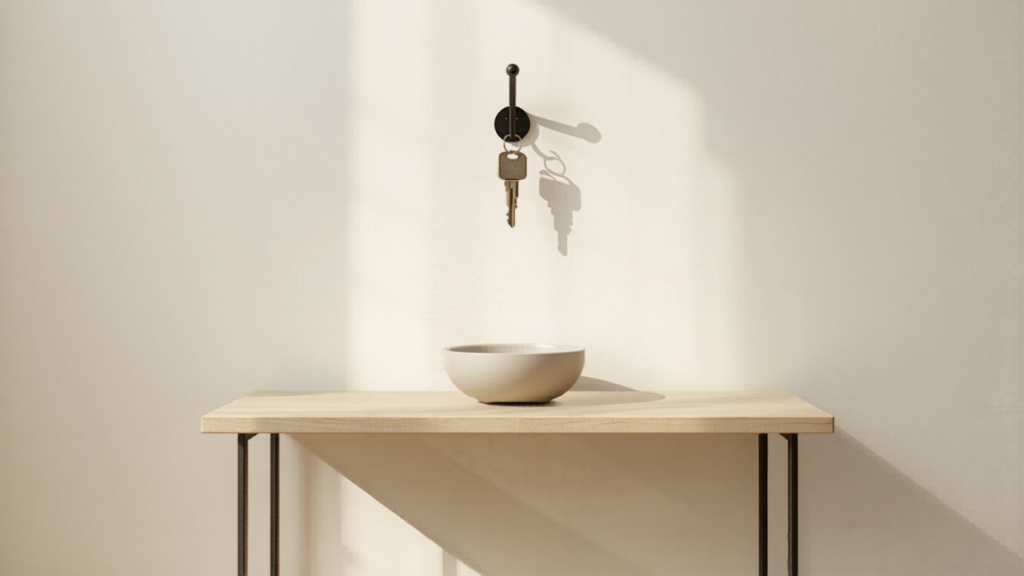
- How to do it: Walk through your apartment and pick any 10 items on surfaces. Ask yourself: does this have a designated home? If not, assign one now. Keys hook by door. Charging cables in one drawer. Books on one shelf. Everything defined.
- Common mistake: Assigning vague homes like “somewhere in the kitchen”. Homes need to be specific. “The left drawer” not “the kitchen”.
4) Apply it ruthlessly to incoming items
- Why it works: New items cause 80% of clutter growth. If every incoming item gets touched once from front door to final home, clutter never builds up.
- How to do it: Grocery bag lands on counter? Unpack immediately. Mail comes in? Sort at the mail spot, not the dining table. Shopping? Clothes to closet, electronics to drawer, receipts to a designated box or trash.
- Common mistake: Letting the entryway become a landing pad. The moment items land there “temporarily”, the pattern is broken.
5) Combine with “if you see it, handle it” for surfaces
- Why it works: Touch-it-once is mainly preventive. For items already in pile form, add a second rule: walking past a cluttered surface, pick up one item and take it home.
- How to do it: Every time you walk past the coffee table, counter, or entryway, grab one item and put it where it lives. Not all of them. Just one. Two dozen walk-bys a day clears any surface by the end of the week.
- Common mistake: Trying to clear a whole pile when you pass. Big efforts fizzle. The one-item rule is small enough to actually happen.
Touch-it-once questions
What is the touch-it-once rule for clutter?
When you pick up an item, take it directly to where it lives permanently, not to a temporary spot. It prevents clutter from forming by eliminating halfway decisions.
Does touch-it-once take extra time?
No, it saves time. The alternative is touching each item 3 or 4 times (pick up, put down intermediate, pick up again, move again, eventually put away). One touch is faster than four.
What if I’m genuinely in a rush?
Don’t pick up non-essential items when you’re rushing. If you touch it, commit to the final placement. If you can’t commit, let it stay where it is. The rule isn’t “always handle everything”, it’s “when you handle, finish it”.
Does this work if I live with someone who doesn’t follow it?
It works for your own stuff no matter what. Your items stay handled. For shared items, try explaining the principle once, then focus on your own behavior. Your visible difference often becomes the persuasion.
What about decorative items that are supposed to be out?
Decorative items are at home. They live on the shelf or the table that’s their display spot. The rule applies to items that aren’t supposed to be where they are, not items that are intentionally displayed.
How do I handle items that don’t have a clear home yet?
The first touch of such an item is used to assign a home. Quick decision: where should this live? Make it and take it there. From that point forward, it has a home and the rule applies cleanly.
Quick checklist
- Every item has a clearly defined home
- When you pick something up, take it home immediately
- If you can’t place it, don’t pick it up
- Apply to incoming items: bags, mail, packages
- Use the one-item-per-walk-by rule for existing piles
What not to do
- Using “I’ll get to it later” as the default. Later is the word that generates piles. Train yourself to hear it as a warning, not a plan.
- Skipping the home-assignment step. Without defined homes, touch-it-once is impossible because there’s no destination.
- Applying the rule only sometimes. It’s a pattern, not a project. Inconsistent application means clutter still builds, just slightly slower.
A trick worth knowing
Assign specific homes to the top five “clutter generators” first: keys, mail, shoes, bags, and whatever your personal problem is (books? water bottles? chargers?). Those five categories generate most apartment clutter. Once they have homes, 70% of the battle is already won.
Handle it now or handle it twice
The touch-it-once rule isn’t a cleaning technique, it’s a habit that prevents cleaning from being needed. One principle, applied every time you pick something up, keeps an apartment perpetually clear.
Start tomorrow. Next item you pick up, ask where it lives, take it there. Do that all day for 3 days. By day 4, you’ll be doing it automatically, and your apartment will look different.