Small Kitchen Setup: 8 Moves That Double Your Counter Space
In this article
Small apartment kitchens share one problem: never enough counter space. You cook on six inches next to the sink, your toaster permanently takes half the counter, and every mug sits out because the cabinets are full. It looks like a square footage issue. It’s almost always a layout issue.
This guide is eight specific moves that double your usable kitchen counter space without renovating, without buying furniture, and without throwing anything away. Most of it is about what goes up, what comes off the counter, and where the dead zones actually are.
💡 Key idea: Counter space isn’t created by clearing things off. It’s created by moving them to the right vertical zone, so the horizontal zone stops working double duty.
If you only read one part
- ✔️ Eight moves that reclaim counter space in under an hour
- ✔️ No buying, no renovating, no permanent changes
- ✔️ Works in any rental kitchen, studio included
- ✔️ Usable counter space doubles on average
Why small kitchens feel crowded even when they’re tidy
A tidy kitchen isn’t the same as a spacious kitchen. You can clean every surface and still feel like there’s nowhere to work. The reason is almost always that items are stored horizontally instead of vertically. A toaster, a coffee maker, a fruit bowl, a knife block, a paper towel stand, a cutting board, and suddenly your counter is a parking lot.
Vertical storage is the unlock. The wall above the counter, the insides of cabinet doors, the gap between the fridge and the wall: these are all dead zones that can absorb 70% of what currently sits on the counter.
8 moves that double your counter space
1) Get the toaster and coffee maker onto a shelf
- Why it works: Small appliances are the biggest counter hogs. Moving them to an upper shelf or cart frees 2-3 square feet instantly.
- How to do it: If you have a tall pantry shelf, put the toaster there. If not, a rolling cart that slides under the counter overhang works. Use the appliance, put it back. The 30 seconds of extra effort saves 3 square feet of permanent counter real estate.
- Common mistake: Assuming appliances need to be permanently visible. They only need to be accessible in 10 seconds, not constantly on display.
2) Use the wall above the counter
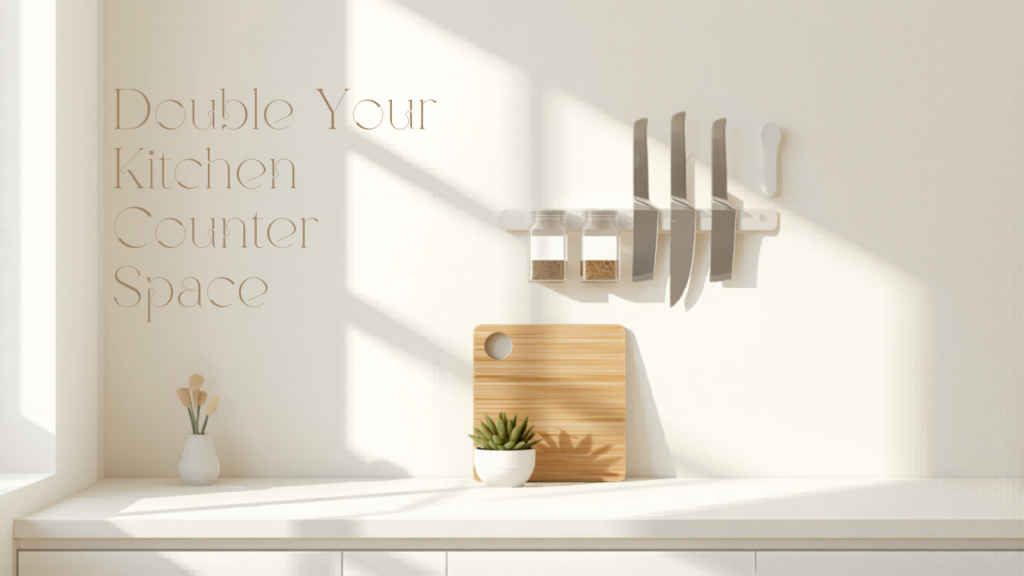
- Why it works: Most small kitchens have 18 inches of empty wall between counter and cabinets. Mounting a magnetic strip or a shallow shelf turns that into storage.
- How to do it: A damage-free adhesive magnetic knife strip holds knives vertically, freeing the knife block. A single shelf at eye level holds spices, oils, and mugs. Renter-safe options use 3M Command strips that peel off cleanly.
- Common mistake: Hesitating because you “can’t drill”. Peel-and-stick hardware holds up to 5 pounds and leaves no marks.
3) Hang pots and pans from a rail
- Why it works: Pots and pans eat an entire cabinet shelf when stacked. Hanging them from an over-sink or wall rail frees that shelf for dry goods.
- How to do it: A suction-cup or adhesive rail above the stove holds 2-3 pans. If you have a window frame nearby, a tension rod between frame edges works as a budget rail. Hook style S-hooks onto the rail and hang the pans.
- Common mistake: Thinking you need a ceiling pot rack. The rail alternatives are renter-friendly and almost as spacious.
4) Inside the cabinet doors becomes storage
- Why it works: Cabinet doors have 10 square feet of flat surface each. Most people use them for nothing.
- How to do it: Adhesive hooks inside door hold measuring cups and oven mitts. Small baskets mounted inside the under-sink door hold cleaning spray bottles. Spice rack inside a pantry door frees the shelf behind.
- Common mistake: Overloading one door. Distribute: one door for measuring tools, another for cleaning supplies, another for spices.
5) Turn the fridge side into magnetic storage
- Why it works: The side of the fridge is usually 4 to 6 square feet of unused magnetic real estate.
- How to do it: Magnetic spice jars, magnetic paper towel holder, magnetic knife strip, magnetic hooks for aprons and towels. All peel off when you move out.
- Common mistake: Filling it with decorative magnets instead of functional ones. Decoration on the front, storage on the side.
6) Use the space between counter and upper cabinet
- Why it works: The vertical gap between countertop and the upper cabinets is typically 18-22 inches. A tension rod or rail uses that space without drilling.
- How to do it: Mount a shallow shelf under the upper cabinet bottom (adhesive versions exist). Hang coffee mugs from hooks attached to the underside of the cabinet. Put paper towel holder there instead of on the counter.
- Common mistake: Packing it with decor. The point is moving counter items up, not adding new items.
7) Move cooking oils and frequently-used items to a wall caddy
- Why it works: Cooking oils, salt, pepper, and utensils are the everyday essentials that permanently sit on the counter. A wall caddy gets them off.
- How to do it: A peel-and-stick wall caddy at arm’s reach from the stove holds 4-6 oils and spice jars. Add a cup with wooden spoons and a spatula in it. The cooking zone becomes vertical, not horizontal.
- Common mistake: Putting the caddy too high. It needs to be at reaching height during cooking, not decorative height. Just below the upper cabinet, or right at eye level.
8) Create a “staging corner” for active items only
- Why it works: Even after all moves, some items need counter access. A designated 12×12 corner for them prevents them from spreading.
- How to do it: Pick the corner closest to the stove. Use a small tray or cutting board as the boundary. Only items currently in use go in this corner. When cooking ends, the corner resets to empty.
- Common mistake: Not resetting the corner. The whole point is that it empties between uses. Without the reset, the staging corner becomes permanent clutter.
Small kitchen questions
How can I maximize counter space in a small apartment kitchen?
Move everything possible off the counter and onto vertical surfaces. Walls, cabinet doors, fridge sides, under-cabinet space. Counters should hold what’s in use right now, not what’s in use next week.
What’s the best renter-safe way to add kitchen storage?
Adhesive hooks and magnetic strips. 3M Command products, magnetic fridge accessories, tension rods inside cabinets. All damage-free, all under $20, all removable in minutes.
What if my kitchen has no wall space at all?
Use cabinet interiors: inside of doors, bottom of upper cabinets (for mug hooks), pull-out drawer organizers. Also use the window frame area above the sink for hanging utensils on a tension rod.
Will adhesive hooks hold enough to store kitchen items?
Yes. Standard 3M Command hooks hold 3-5 pounds each, which covers knives, mugs, light pans, and spice jars. For heavier items like cast iron pans, use multiple hooks distributing the weight.
How do I avoid damaging walls when I move out?
Stick to adhesive-based and magnetic storage. All 3M Command products peel off cleanly when pulled slowly downward. Magnetic fridge accessories leave no trace. Skip anything requiring nails or drilling.
Should I buy matching storage for a unified look?
Function first, aesthetics second. Matching storage looks polished but usually costs 3x more. Get the function solved, then replace individual pieces over time with matching ones if the look matters to you.
Run through this
- Toaster and coffee maker moved off counter
- Magnetic knife strip on the wall or fridge side
- Pots and pans hanging, not stacked
- Inside of cabinet doors used for storage
- A single staging corner, reset daily
Avoid these
- Trying to “add” storage without “removing” from counter. Storage on the wall only helps if counter items actually migrate there.
- Using bulky organizers. Small kitchens need flat, low-profile storage. Chunky bins eat more space than they save.
- Not maintaining the reset. The biggest driver of kitchen clutter is letting staging items stay overnight. Nightly reset keeps the system working.
One more thing
Do the reorganization as a single 1-hour session, not gradually. Pull everything off the counter, then put back only what earns its spot based on daily use. Items used once a week go to cabinets, items used monthly go to pantry, items used less than that go to donation. You’ll end with 2x the counter space and 1 bag to donate.
Counter space is made, not found
Small kitchens don’t need renovation, furniture, or a bigger apartment. They need vertical storage, damage-free hardware, and a rule about what stays on the counter.
One hour of rearranging doubles the working space for the next several years. Almost no other home project has that return.