The One In, One Out Rule: The Simplest Way to Control Small Apartment Clutter
Your apartment fills back up within a week of cleaning. Every time.
It’s not that you’re messy. It’s that stuff comes in faster than it goes out.
One rule fixes that.
> 💡 **Key idea:** For every new item that enters your apartment, one item leaves. This keeps total volume constant, which means clutter can never accumulate past a set ceiling.
## Quick summary (for busy people)
– ✔️ One in, one out means your apartment can never get fuller than it is today
– ✔️ The rule works for everything: clothes, kitchen tools, books, decor
– ✔️ You pick what leaves: it just has to leave the same day the new thing arrives
– ✔️ This habit takes 2 minutes to apply and prevents the weekend declutter marathon
## Why apartments fill up even when you’re not trying
Every week something new comes in. A delivery. A grocery haul. A gift. A random thing you needed.
What doesn’t happen automatically: something leaving.
The math is simple. More in, nothing out = clutter. The one in, one out rule resets the math permanently.
## How to apply the rule
### 1) Apply it the moment the new item arrives
– **Why it works:** Waiting until later means it never happens. The decision is easiest in the moment when you’re already thinking about the new item
– **How to do it:** When something new comes in, immediately ask: what’s leaving? Find the thing, put it in the donate bag or trash right then
– **Common mistake:** “I’ll figure out what to leave later.” Later never comes. Do it in the moment, always
### 2) Match category to category
– **Why it works:** It keeps your storage zones from shifting and prevents “overflow” into other areas
– **How to do it:** New shirt in means an old shirt out. New kitchen gadget in means an old one out. Don’t let a new book fill your closet because you removed a kitchen item
– **Common mistake:** Removing an unrelated item just to say you did it. A new winter coat should replace another coat, not a mug
### 3) Keep a permanent donate bag by the door
– **Why it works:** If the bag is there, items go in it. If it’s not, items go back on shelves
– **How to do it:** Keep a reusable bag just inside your door or in your closet. When it fills, drop it at a donation bin. Never let items “wait” on a surface
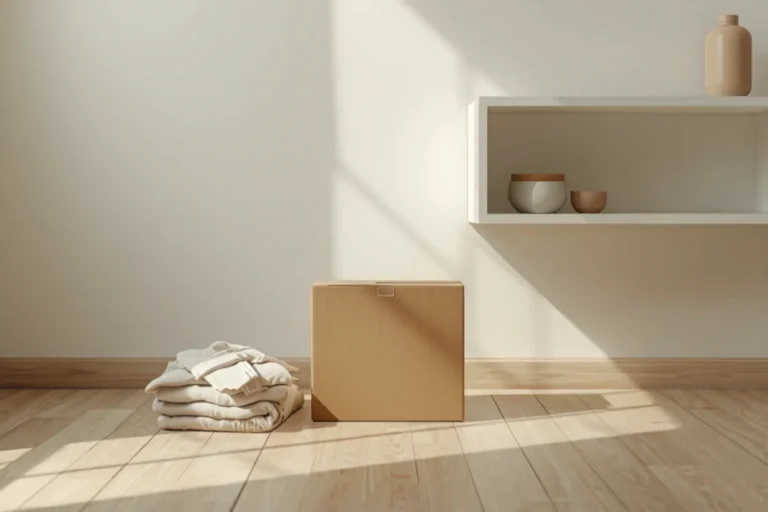
– **Common mistake:** Using a random box that becomes a pile. Use a bag: it signals donation, not storage
### 4) Apply it to digital and paper too
– **Why it works:** Paper clutter follows the same accumulation pattern as physical clutter
– **How to do it:** New document in means an old one filed or shredded. New receipt = scan it and toss the paper. New magazine = old one goes to recycling before you read the new one
– **Common mistake:** Treating paper as “different.” It piles just as fast and takes just as much space
## Quick answers
### What’s the best way to control clutter in a small apartment?
The one in, one out rule. Applied consistently, it creates a natural ceiling on how much stuff your apartment can hold, without requiring periodic declutters.
### How often should you apply the rule?
Every time something new enters. Not weekly, not monthly. Every single time.
### What happens if you skip it even once?
One skip becomes two. Two becomes a pile. The rule only works with 100% consistency: the good news is it takes 2 minutes per application.
## Practical checklist
– [ ] New item arrives → immediately decide what leaves
– [ ] Match category: clothes replace clothes, tools replace tools
– [ ] Donate bag kept in a permanent visible location
– [ ] Paper items filed, scanned, or recycled the same day they arrive
– [ ] Nothing “waits” on a surface to be dealt with later
## Common mistakes
1. Waiting to decide what goes out. The decision has to happen the same moment the item comes in
2. Removing unrelated items. Keep categories matched or your storage zones shift
3. Not having a donate bag ready. No bag = no donation = items pile back up
## Pro tip
For big purchases like furniture or appliances, decide what’s leaving *before* the new item arrives. Post a photo in a local buy-nothing group or schedule a donation pickup in advance. It forces the decision when your intention is highest.
## Conclusion
One rule. Two minutes per application. No more clutter ceiling creeping upward. The one in, one out rule doesn’t require willpower over time, it just requires the habit of asking one question every time something new crosses your threshold.
- 5 No-Clutter Systems That Actually Work in Small Apartments
- The Touch-It-Once Rule: How to Stop Apartment Clutter Before It Forms
- The Drawer-by-Drawer Method: Reset Your Apartment 15 Minutes at a Time
## FAQ
### Does one in, one out apply to groceries?
Not to consumables: food, toiletries, cleaning supplies. It applies to objects that take permanent space: clothes, tools, decor, books, gadgets.
### What if I get a gift I didn’t choose?
Apply the rule anyway. The gift comes in, something else goes out. The giver doesn’t need to know, your space does.
### What if I can’t find anything to remove?
That’s usually a sign the category is already lean. In that case, keep the new item and flag the category for a light review next weekend, not a full declutter, just a 10-minute scan.