The Two-Bin System: How to Keep Laundry from Taking Over Your Floor
Laundry ends up on the floor, the chair, or the bed. Rarely in the hamper. And when clean and dirty mix, you spend 10 minutes figuring out what to rewash.
Two bins. That’s all it takes.
> 💡 **Key idea:** One bin for dirty, one bin for “worn but not dirty.” Most clothing chaos happens in the middle zone: items that don’t go back in the closet but aren’t ready to wash. Give that zone a home.
## Quick summary (for busy people)
– ✔️ Bin 1: dirty laundry (goes directly to wash)
– ✔️ Bin 2: worn-but-clean items (jeans, hoodies, gym clothes worn once)
– ✔️ The floor and the chair are no longer valid laundry destinations
– ✔️ Bin 2 empties on laundry day: everything in it gets washed or returned to the closet
## Why clothes end up on the floor
It’s not laziness, it’s the absence of a decision system.
You take off a pair of jeans. Too worn to put back in the closet, not dirty enough to wash. So they go on the chair.
Then a hoodie. Then a shirt. The chair becomes the third closet.
Two bins eliminate the chair entirely.
## How to set up the system
### 1) Place both bins in the bedroom, not the bathroom
– **Why it works:** Clothes come off in the bedroom. The system needs to be where the behavior happens
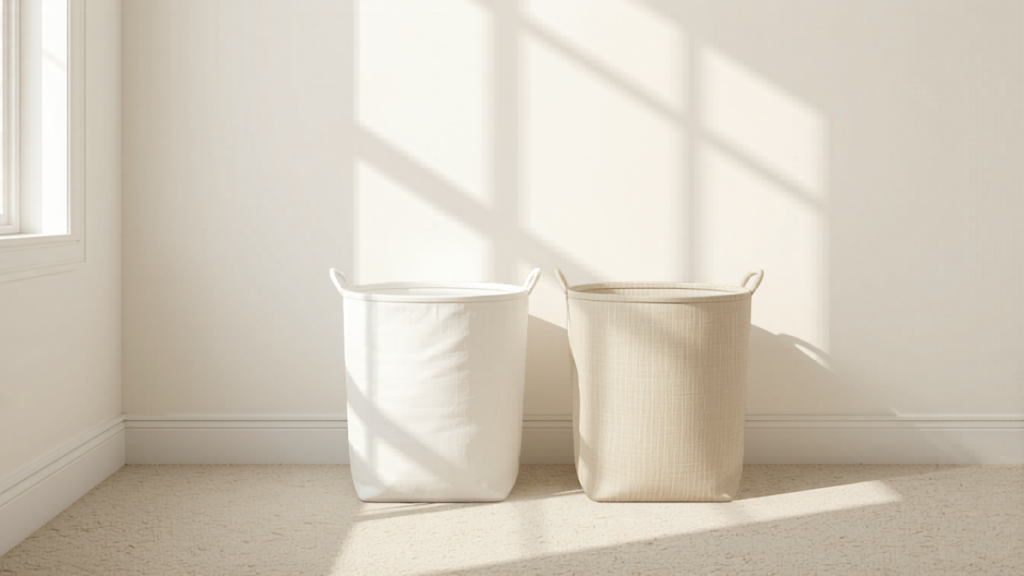
– **How to do it:** Use two matching fabric bins, one slightly larger (dirty) and one medium (worn-clean). Stack or place them side by side near the closet or behind the door
– **Common mistake:** Putting the dirty bin in the bathroom. You take clothes off in the bedroom. The bin goes there
### 2) Label them, even just mentally
– **Why it works:** In the moment of deciding where something goes, having a named category removes the “I’ll figure it out later” response
– **How to do it:** You don’t need physical labels if you know the rule: left bin = worn, right bin = dirty. Or use two different colors. Just make the distinction immediately obvious
– **Common mistake:** Using bins that look identical. Different size or color makes the decision automatic
### 3) Define what goes in bin 2 (worn-clean)
– **Why it works:** Without clear criteria, bin 2 becomes a dump zone
– **How to do it:** Bin 2 is for: jeans (worn once or twice), hoodies (not sweaty), gym clothes worn for short sessions, jackets and outerwear. Anything with visible stains, sweat, or smell goes directly to bin 1
– **Common mistake:** Letting bin 2 grow indefinitely. If an item has been in bin 2 for two laundry cycles, it either goes to the closet or gets washed
### 4) Empty both bins on laundry day
– **Why it works:** A fixed laundry day prevents the bins from overflowing and removes the ongoing decision of “when should I wash this”
– **How to do it:** Pick one or two fixed laundry days per week. On that day, bin 1 goes directly to the machine. Bin 2 gets reviewed: each item either goes back to the closet or into the machine
– **Common mistake:** Irregular laundry. Without a fixed schedule, both bins fill and the floor problem returns
## Quick answers
### What’s the best way to keep laundry off the floor?
The two-bin system. One bin for dirty laundry, one for worn-but-not-dirty items. The floor is never a laundry destination: everything goes in one of the two bins.
### How often should you do laundry with this system?
Once or twice a week. Bin 1 usually fills in 4-5 days. Laundry day empties both bins and resets the system.
### What happens if you skip bin 2?
The floor and the chair fill up again. The “worn-clean” zone needs a physical home: without one, it lands wherever is convenient.
## Practical checklist
– [ ] Two bins placed in the bedroom (not the bathroom)
– [ ] Bins visually distinct (different size or color)
– [ ] Bin 1 rule: anything dirty or sweaty
– [ ] Bin 2 rule: worn-once items: jeans, hoodies, outerwear
– [ ] Fixed laundry day(s) established
– [ ] Bin 2 reviewed on laundry day: closet or wash, nothing stays
## Common mistakes
1. Putting the hamper in the bathroom. Clothes come off in the bedroom
2. Identical bins. Different visual = automatic decision
3. Letting bin 2 accumulate past two laundry cycles. Review and clear every wash day
## Pro tip
Put a small hook on the back of the bedroom door for tomorrow’s outfit. Takes 30 seconds the night before, eliminates the “what do I wear” scramble in the morning, and keeps the bin 2 items from piling up because you need them again tomorrow.
## Conclusion
Two bins, one rule per bin, one fixed laundry day. The floor becomes a floor again. The chair goes back to being a chair. And you never rewash something because you couldn’t tell if it was dirty.
Nearby topics
- How to Organize a Small Closet With No Extra Furniture
- 5 No-Clutter Systems That Actually Work in Small Apartments
- The One In, One Out Rule
## FAQ
### What size bins work best for this system?
Bin 1 (dirty): large enough for 5-6 days of clothing. Bin 2 (worn-clean): medium. It should fill slowly. If bin 2 fills fast, you’re putting too much in it.
### Can I use this system in a studio apartment with no bedroom?
Yes. Place both bins in your closet or near the area where you change. The principle is the same: the bins go where the clothes come off.
### What about workout clothes?
Sweaty gym clothes go directly to bin 1, always. Gym clothes worn for a short low-intensity session can go to bin 2, but wash within 24 hours: they hold bacteria faster than regular clothes.