The Visible Storage System: How to Organize Without Hidden Clutter
In this article
Hidden storage creates a problem: out of sight means out of mind. Things get stuffed into drawers and cabinets and never found again.
Visible storage flips this: everything you own is accessible, but everything needs to earn its place because it can be seen.
> 💡 Key idea: Visible storage forces curation. When everything can be seen, the motivation to only keep what you want to look at is real.
The gist
- ✔️ Open shelving works when items are uniform and curated
- ✔️ Matching containers create visual calm even with full storage
- ✔️ The “display rule”: only things you like looking at go in visible storage
- ✔️ Labeled containers: you can have visible storage without visual chaos
How to build a visible storage system
1) Define what “visible” means for your space
- How it works: Not all storage needs to be visible. Decide which areas will be open/visible and which can be closed/hidden. Good candidates for visible: books, plants, frequently used kitchen items. Good candidates for hidden: cleaning supplies, cables, medical items.
- Common mistake: Trying to make all storage visible, which requires perfect curation constantly.
2) Matching containers are the foundation
- How it works: Diverse containers with different shapes and colors create visual chaos even when organized. Matching containers create calm even when full.
- Standard system: 3-4 containers of the same style in different sizes. Clear glass or white ceramic for most uses. Label the front or lid.
- Common mistake: Buying attractive individual containers that don’t coordinate with each other.
3) The display rule
- How it works: Only items you actively like looking at belong in visible storage. Everything else belongs in a drawer, cabinet, or box.
- Practice: For each item in visible storage, ask: “Do I like seeing this?” If neutral or no, it doesn’t belong visible, it belongs stored elsewhere.
- Common mistake: Putting things in visible storage because they’re hard to find a “hidden” home for.
4) Group by category, not aesthetics
- How it works: Visible storage organized by function is more useful than organized by color or visual grouping.
- Application: Books together. Decor objects grouped by purpose (candles together, plants together, ceramics together). Active use items grouped by activity.
- Common mistake: Organizing by appearance alone, which makes things hard to find.
Visible storage questions
Is visible storage compatible with a small apartment?
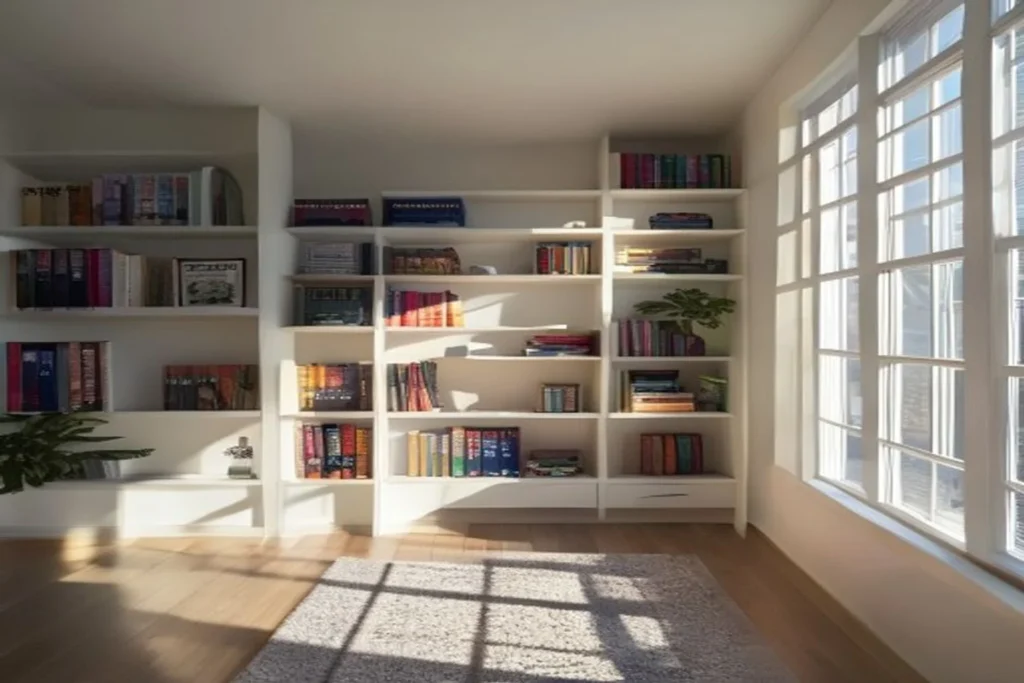
Yes, often more so than closed storage. Open shelving feels less heavy visually. The curation requirement actually keeps the apartment less cluttered because items need to earn visible placement.
What about dust on open shelves?
Real consideration. Weekly wipe during the regular reset handles it. If dusting frequency is a dealbreaker, closed storage is a legitimate preference.
How do I prevent visible storage from becoming a dumping ground?
The display rule. Apply it consistently. When something doesn’t have a permanent home and ends up on visible storage “temporarily,” that’s a signal that it either needs a proper home or needs to leave.
What’s the best open shelving for small apartments?
Floating shelves are the most space-efficient option: they take up no floor space and can be placed anywhere wall space is available. IKEA LACK or similar simple floating shelves work for most needs.
How many items should be on a shelf to look good?
The 60/40 rule: 60% filled, 40% empty space. More than that and it looks cluttered. Less and it looks sparse and unintentional.
Run through this
- ☐ Visible and hidden zones defined
- ☐ Matching containers purchased for primary visible storage areas
- ☐ Display rule applied: only items you like looking at in visible storage
- ☐ Categories grouped by function, not just aesthetics
The usual missteps
- Mixed container styles destroying the visual calm the system is supposed to create.
- Visible storage as overflow for hidden storage: defeats the purpose.
- Not labeling containers that contain non-obvious contents.
One thing that helps
Before buying any storage container, stand back and look at the space it will go in. Take a photo. Then stand in a store or shop online and select what would actually look right in that photo. The context check prevents a lot of purchases that look good in the store but wrong in the space.
If it is out, it earns its place
Visible storage systems work best when they’re treated as display, not storage. The curation pressure they create is a feature, not a bug: it keeps the apartment honest about what you actually want in your space.